By John “Coach” Hughes
A year ago, this past Labor Day weekend in 2025, I almost drowned. Even now, that sentence is difficult to write. I grew up about a half mile from the Jersey Shore and spent much of my life in and around the ocean. When I was younger, I took a lifeguard course, surfed, boogie boarded, body surfed, and later competed in triathlons into my mid-forties. I considered myself a pretty good swimmer, and more importantly, I thought I understood the ocean. I thought I knew what I was doing.
About two weeks before our family vacation, a hurricane had moved up the East Coast. It never made landfall near us, but it left rough seas and strong currents behind. Growing up at the Jersey Shore, we would have simply called the ocean gnarly. By the time we arrived, conditions appeared to be improving. It was September, one of my favorite times of year at the Shore. The crowds were gone, the water was still warm, and everything looked peaceful. Our beaches are guarded from Memorial Day through Labor Day, but after Labor Day, the lifeguards are gone. For those of us who grew up there, September always felt like a special time at the beach.
There was something else I wasn't giving enough consideration to. I had recently turned 60 and was less than a year removed from having both hips replaced. I had healed enough that I could swim, but my strength wasn't what it once was. My body probably understood that better than my mind did. In my head, I was still the guy who had spent his entire life around the ocean.
The day before I almost drowned, I took a longboard out hoping to catch a few waves. It had probably been 30 years since I had really surfed, and the water was choppy. I stayed out for a while trying to catch something before finally realizing it wasn't going to happen and deciding to head back in. As I paddled toward shore, I noticed the current was pushing me back out. I wasn't exhausted. I had a longboard underneath me, and the waves weren't particularly big, but getting back to shore took more effort than I expected. It made me a little nervous. Eventually, I made it in, and once my feet were back on the sand, I brushed it off. Looking back, that should have been my warning.
WHEN TRYING HARDER MAKES IT WORSE
The next day, my brother-in-law and I were sitting on the beach when I decided to go body surfing. The waves were breaking about 50 yards offshore. The tide was low, the waves looked manageable, and I put on my fins and headed out. I felt good. I felt strong. I tried to catch wave after wave, probably 10 or 12, without much success. It didn't help that I wasn't as fit or as strong as I had once been. Eventually, I became tired and decided to head back in.
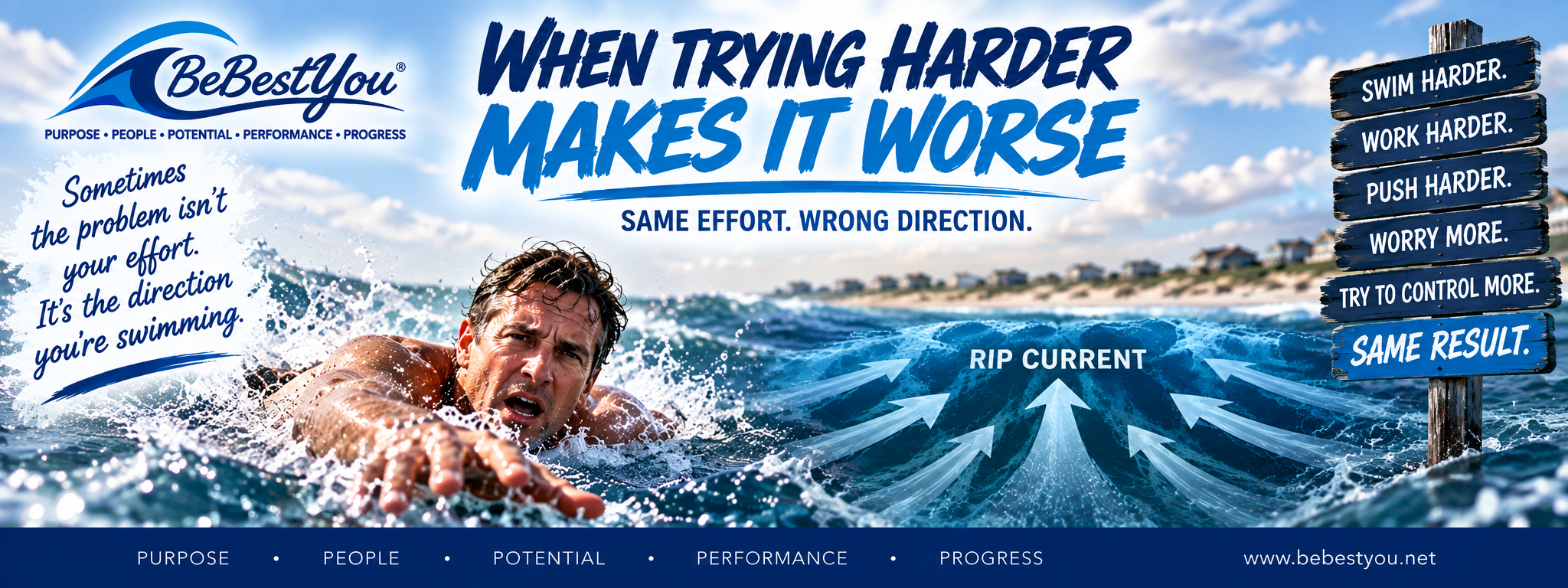
I started swimming toward shore. After a dozen or so strokes, I lifted my head and looked. I wasn't any closer. So, I put my head down and swam harder. After a while, I looked again. Still no closer. I swam harder again, and that's when I realized I wasn't simply failing to make progress. I was being pulled farther away from shore.
My first reaction was to do what most of us do when something isn't working: try harder. But the harder I swam, the more exhausted I became. My heart rate increased. My breathing became faster. Concern became fear, and fear quickly became panic. For the first time in my life, I genuinely thought I might drown.
I looked toward shore and saw my brother-in-law. Instead of yelling, "Help!" I yelled, "Surfboard!" One thing I remembered from ocean safety was that I didn't want someone swimming out to rescue me without something that could keep both of us safe. If you're caught in a rip current and already in danger, even a strong swimmer coming out without flotation can leave you with two people in trouble instead of one. At first, my brother-in-law thought I wanted the surfboard so he could come out and join me. Then he and some other people on the beach realized something wasn't right. Thankfully, he didn't swim out. He ran about 200 yards back toward the house to get the surfboard.
STOP. BREATHE. PRAY. RESPOND
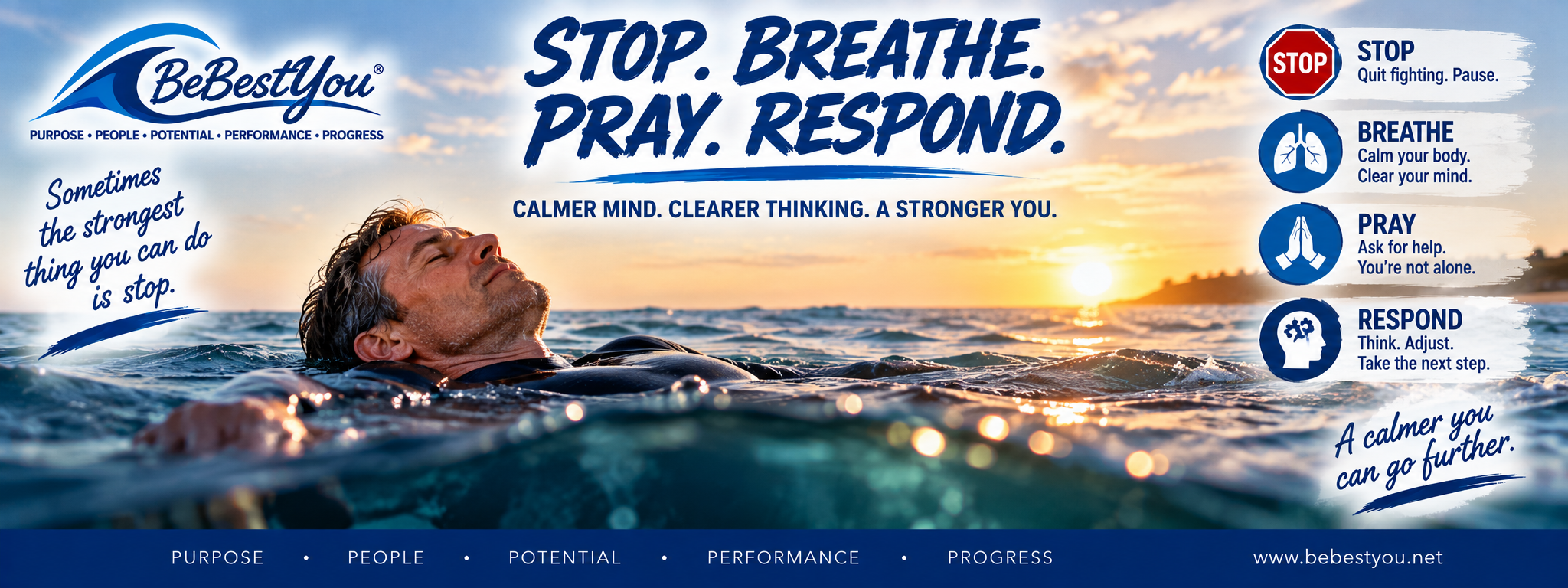
And suddenly, I was alone. Scared isn't the right word. I was terrified. I kept trying to swim, but eventually I realized I couldn't keep fighting the current. I stopped swimming and rolled onto my back. One of the clearest things I remember from that moment is how blue the sky was. I thought about my wife. I thought about my kids. And then I prayed: "Dad, help me. God, save me."
I choose to believe what happened next was an answer to those prayers. A small wave came and pushed me a little closer to shore. It wasn't a big wave, but it moved me enough to give me hope. I slowed my breathing and tried to calm myself. Then another small wave came. God didn't swim for me. I still had to do the work. But I believe I was given exactly what I needed in that moment—not someone doing it for me, but an opportunity to save myself. Those little waves pushed me just enough toward shore, almost as if someone were saying, "I've got you. You can do this."
“Those little waves pushed me just enough toward shore, almost as if someone were saying, ”I’ve got you. You can do this.””
As I became calmer, something else happened. My training came back. My ability to think came back. The ocean hadn't changed. The current hadn't changed. I had changed. Instead of reacting to what was happening, I began responding to it. I took a few strokes toward shore and then stopped. I rested. I breathed. I prayed. Then I took a few more strokes. Little by little, I began making progress.
Eventually, my feet touched the bottom. I dug my fins into the sand, but I could still feel the force of the current pulling my legs and feet back toward the ocean. That was when I fully understood just how powerful the water had been. Mother Nature was in charge. I couldn't control the ocean. I couldn't control the waves. I couldn't control the current. But I could control my breathing. I could control my thinking. I could control whether I panicked. I could control whether I prayed. And I could control whether I took the next stroke. I had regained control of myself.
Eventually, I made it back to shore. My brother-in-law arrived with the surfboard, my wife came running down, and I was still running on shock and adrenaline. Later, a police officer told me it had been one of the worst summers he could remember for ocean rescues and drownings. He had grown up there his entire life, and then he said something I'll never forget: "I wouldn't have gone in the water today." Someone had drowned about a half mile away the night before.
The rest of that day was mostly a blur. I was quiet. I tried to move on and convince myself everything was okay. It wasn't until the next morning, when my brother-in-law and I sat looking out at the ocean, that the reality finally hit me. The ocean looked peaceful again. Looking at it, you would have had no idea what had happened underneath that same surface the day before. And then it hit me. I had almost drowned. I had almost died. That's when the emotions came rushing out.
A few weeks later, during a personal coaching session, I told the story. My coach listened and then asked me a simple question: "What do you think saved you?" That question stayed with me. I thought about the moment when I stopped swimming and rolled onto my back. The first thing I did was pray and call out to my dad. I remember that clearly. I asked them to help me. I would like to believe those little waves were my prayers being answered and God giving me exactly what I needed in that moment—not necessarily doing it for me, but giving me the chance to save myself.
I also thought about what happened when I finally stopped fighting. My breathing slowed. The panic began to disappear. My training returned. I could think again. I stopped reacting and started responding. That's when I realized this wasn't just a story about almost drowning. It was a lesson about life.
LIFE HAS RIPTIDES TOO
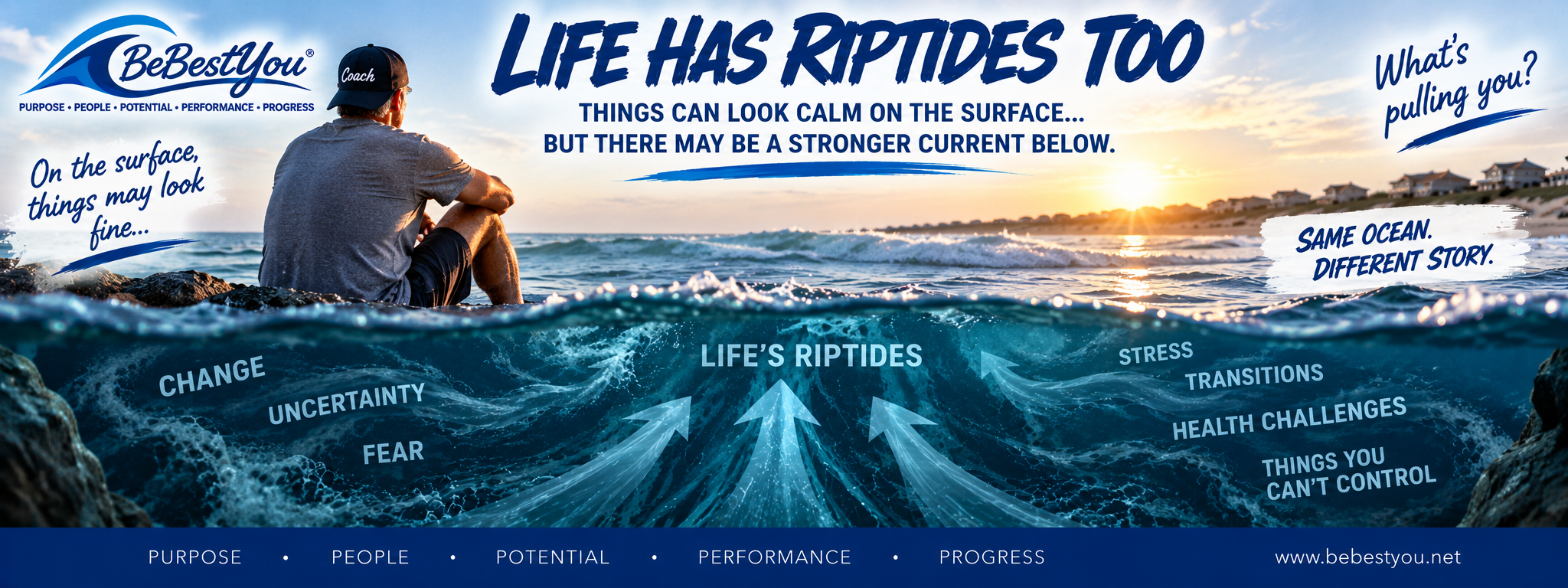
At the time, I was already caught in another kind of riptide. I had just turned 60. I had both hips replaced. The company I had spent roughly four decades with had been sold. There was change all around me and uncertainty inside me. On the surface, things may have looked fine, but underneath, things were churning. There was change, fear, uncertainty, questions about what came next, and things I simply couldn't control. It was messy. It was gnarly, just like the ocean.
“Mother Nature had reminded me that I couldn’t control everything, and Mother Time was teaching me the same lesson. I couldn’t control my age. I couldn’t change the fact that I had needed two new hips. I couldn’t control the sale of the company or everything changing around me. But I could control what I did next.”
When we get caught in one of life's riptides, our first instinct is often to fight harder. We work more, worry more, push more, and try to control more. We convince ourselves that if we just work harder, swim harder, or fight harder, we'll eventually get where we're trying to go. Sometimes that works. Sometimes it just wears us out.
Sometimes we need to stop swimming. Not quit. Not give up. Just stop fighting long enough to regain control. We need to pause, rest, recover, breathe, and become calm. We need to ask for help and pray. We need to think instead of panic, respond instead of react, trust what we've learned, take a few strokes forward, rest again, reassess, and then take a few more.
REFLECTION TURNS EXPERIENCE INTO PROGRESS
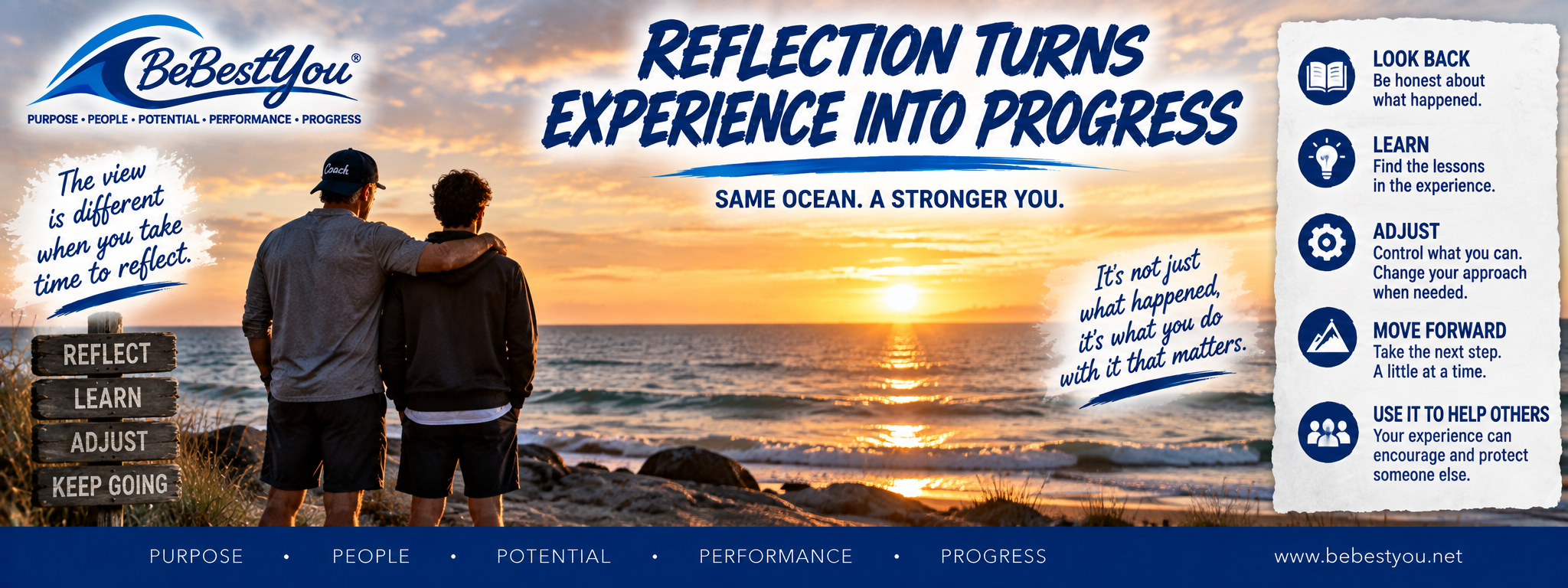
One of the biggest lessons that experience taught me is that stopping doesn't always mean quitting. Sometimes stopping is exactly what keeps us going. Rest isn't weakness. Asking for help isn't weakness. Prayer isn't weakness. And thinking you can do everything alone doesn't make you stronger.
We take faith for granted sometimes. We forget to ask for help until we've exhausted every other option. That day in the ocean reminded me that sometimes the first thing we should do is the thing we often save for last: pray.
I also learned that progress doesn't always come through one big heroic effort. I didn't get back to shore with one great swim. I got there a few strokes at a time. I would swim a little, rest, breathe, pray, and then take a few more strokes. I would rest again, reassess where I was, and then keep moving. Little by little, stroke by stroke, I got closer to shore.
Life isn't much different. Sometimes the shore seems a long way away. Sometimes the current is stronger than we expected. Sometimes what worked for us in the past doesn't work anymore. Sometimes the warning signs are there, and we ignore them. Sometimes what looks calm on the surface is anything but calm underneath. And sometimes, despite all our experience, confidence, and preparation, we simply need help.
That day taught me that I can't always control the riptide, but I can control how I respond to it. I can't control every wave. I can't control every current. I can't control everything life puts in front of me. But I can control my next response.
Sometimes you need to stop. Sometimes you need to float. Sometimes you need to breathe. Sometimes you need to ask for help and learn to pray. And then, when you're ready, take a few more strokes.
Rest. Breathe. Respond. Pray. Swim. Repeat.
And keep moving toward shore.